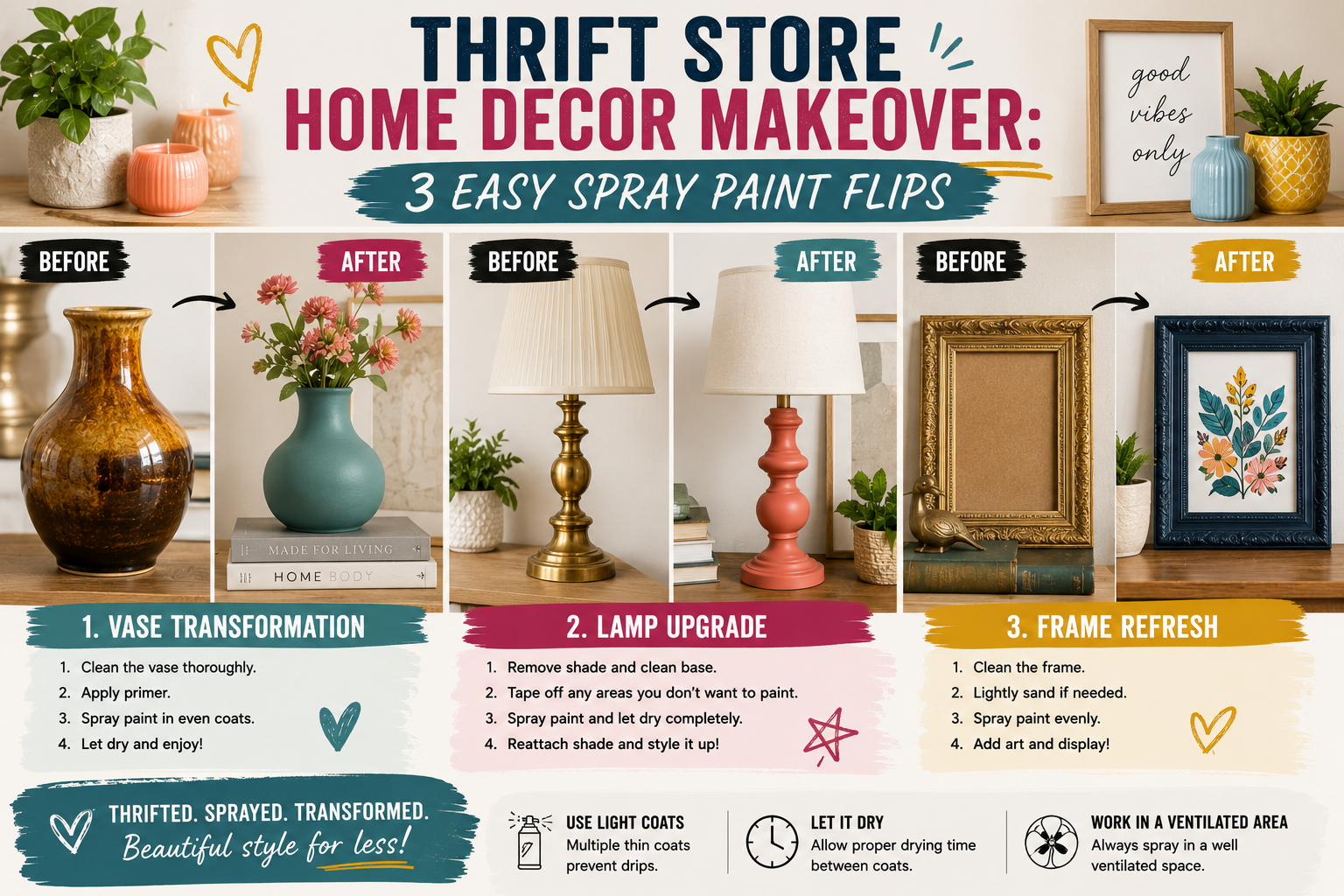
What if I told you that the high-end look you’ve been saving up for could come from a yard sale table and a single can of spray paint? That’s exactly what I proved on my most recent thrifting run. Everything I’m about to show you started as a forgotten yard sale find — most of it under $2 — and walked away looking like it belongs on the shelves at Pottery Barn. That’s the magic of a thrift store home decor makeover done right.
I’ve been doing budget flips like these for years, and I’m always amazed at how a little spray paint and some antiquing wax can completely change the story of a piece. If you’ve been hesitant to try thrift flipping because you think it takes special skills or expensive supplies, I’m here to prove you wrong. These three projects cost me under $10 total, and the results genuinely look designer-quality. If you love budget-friendly home upgrades, you’ll also want to check out my post on budget home design ideas on a dime that make big impact for even more inspiration.
Let me walk you through each of the three flips I tackled — from a set of wicker trays to a gilded leaf tray to a Victorian-style candlestick holder. I’ll cover every step so you can recreate any (or all) of these yourself. Let’s get into it.
Flip #1: Wicker Trays With Leather Handles — From $2 to Designer-Worthy
On my most recent yard sale trip, I spotted a set of wicker trays with leather handles. There were originally three in the set, but only two were left — one large and one small. I came home with the pair, and honestly, that’s all I needed. Here’s the thing about wicker trays: pieces like these with woven texture and leather handles can run anywhere from $20 to $300 at high-end home stores. I paid under $2 for the pair.
The shape was perfect, but the color was not. There was a blue stripe, a little cross detail, and an overall bluish tint that wasn’t working for me. So before anything else, I taped off the leather handles with masking tape to protect them from catching any paint. Then I headed to Home Depot for spray paint. I originally had my heart set on a khaki Rustoleum, but they were out of that shade. I grabbed a chalk finish spray paint in rustic taupe instead — and I’m so glad I did. Chalk finish spray paint dries to a soft, ultra-matte, velvety finish. It grips beautifully to wicker, rattan, glass, and even metal with no sanding and no primer needed, which makes it absolutely perfect for this kind of project.
I gave each tray one solid, even coat and let them dry completely. Once dry, I took things one step further with a brown antiquing wax — a dark tinted wax that acts as a secret weapon for adding depth. Instead of a flat painted color, the wax sinks into all the woven textures and gives the piece a warm, woody, lived-in patina. I brushed on a light coat all over, then went back over everything with a paper towel to blend it out. One important tip: leave at least 20 minutes between coats so the wax has time to settle in before you work it. I pulled off the tape, repeated the whole process on the second tray, and the results were stunning. These now look gorgeous styled on a shelf, a coffee table, or an entryway table — and I’ve even used one as a catch-all basket. The spray paint alone is enough to completely transform wicker, but the wax step takes it to a whole new level.
Color Variation Ideas for the Wicker Tray Flip
One of the things I love most about this technique is how flexible it is. The rustic taupe with brown wax is my personal favorite result, but the color options here are really wide open. If you use a black wax instead of brown, you’ll get more of a soft aged gray finish — which looks incredible against the taupe base. You could also skip the wax entirely and leave the trays at just the painted color for a cleaner, more modern look.
Another option I’ve tested is dry brushing a contrasting paint color over the top after the base coat dries. This adds a layered, textural effect that looks intentional and high-end. The point is: don’t feel locked into exactly what I did. Once you have the base technique down, you can experiment freely. That’s the beauty of working with spray paint and wax — the materials are inexpensive enough that experimentation is low-risk and high-reward.
Flip #2: The Gilded Leaf Tray — From Iridescent to Antique Gold
From the same yard sale, I picked up a pretty leaf-shaped tray for $2. The shape was absolutely lovely — those natural veins and ribs running through the leaf form are exactly the kind of organic detail that makes a piece feel elevated. But it had an iridescent finish that just wasn’t my style. The good news? That’s a completely fixable problem with the right approach.
Here’s an important tip I want you to remember for any slick, shiny surface: don’t go straight in with an antiquing wax or gilding wax because it will slide right off. You need a base coat for the wax to grip to. For my base, I used a black spray paint in a shade called “dark canyon” to create a rich, dark foundation underneath the gold. While that black was still wet, I went in with an antique gold spray paint. I specifically chose an antique gold rather than a bright brassy one — it reads warm and old-world, which makes it feel expensive rather than costume-jewelry shiny.
I gave the gold just a light spritz all over, and here’s the beauty of working while the base is still wet: if you mess up or apply too much, you can dab it back with a paper towel and it blends right in. I did the back of the tray first and let it fully dry before flipping to the front. Interestingly, the back actually became my favorite side — all those little ribs and veins caught the gold beautifully, creating this gorgeous dimensional finish. I repeated the exact same process on the front. If you’d rather skip the wet-application technique, you can also let the piece dry completely and rub gilding wax over the top instead for similar gilded highlights. This tray is now the perfect catch-all for a coffee table or side table — somewhere to drop your keys and jewelry, or honestly just a standalone piece of decor.
Flip #3: The Candlestick Holder — Transforming Cheap Finds Into Aged Cast Iron
My third and final yard sale find was a candlestick holder — the kind that holds multiple candles, similar to styles you’d find at Pottery Barn for a pretty penny. I was thrilled to find this one because multi-candle candlestick holders can get seriously expensive at high-end home stores. Start to finish, this entire project cost me under $5, including the spray paint.
For step one, I used the same black spray paint and covered the entire piece. The key here is to take your time and keep turning the piece as you go so you can get into all the nooks and crannies — don’t forget to spray the inside of any hollow areas too. You want solid, even coverage everywhere. Once that was fully dry, I tried something I’d never done before: dabbing black wax on with a paintbrush rather than rubbing it in with a cloth.
The result completely blew me away. The dabbed-on black wax gave the candlestick this gorgeous aged Victorian cast iron look — almost like real wrought iron. It added dimension, texture, and a sense of history to what was otherwise a plain piece. I’m completely obsessed with how it came out. This is a great reminder that sometimes the best discoveries in DIY come from just trying something new and seeing what happens. If you enjoy transforming budget finds with paint and creative techniques, my post on paint ideas for a home color makeover has even more ideas worth exploring.

Tips and Best Practices for a Thrift Store Home Decor Makeover
After testing these three projects and many others like them, here are the key lessons I’d pass along to anyone doing their own thrift store home decor makeover:
Always prep your surface correctly. For porous surfaces like wicker and rattan, chalk finish spray paint adheres without sanding or primer. For slick or glossy surfaces, always lay down a base coat first so subsequent layers — especially waxes — have something to grip. Skipping this step is the number one reason thrift flips don’t turn out as expected.
Work in thin, even coats. Whether you’re using spray paint or wax, thin coats are always better than one heavy coat. Heavy applications lead to drips, uneven coverage, and longer dry times. With spray paint, keep the can moving in smooth, sweeping passes. With wax, apply a light coat, let it settle for at least 20 minutes, then buff or layer as needed.
Use wax to add depth and character. Flat paint is fine, but antiquing wax — whether brown or black — is what separates a painted thrift flip from a truly designer-looking piece. The wax sinks into texture and crevices, mimicking the natural patina that develops on aged furniture and decor. It’s one of the most powerful and inexpensive finishing tools in a DIY decorator’s arsenal.
Shop with an open mind. The best thrift flips often come from pieces you have to look past the current color or finish to see the potential underneath. Train yourself to evaluate shape, texture, and structure first — the finish is almost always fixable. Pieces with interesting textures like wicker weave, leaf veining, or decorative molding respond beautifully to paint and wax techniques. For more ideas on refreshing your space without spending a fortune, check out my full list of affordable home improvement projects under $100.
Frequently Asked Questions
What kind of spray paint works best for a thrift store home decor makeover?
For textured surfaces like wicker and rattan, chalk finish spray paint is my top recommendation. It dries to an ultra-matte, velvety finish and adheres without sanding or primer. For smooth or slick surfaces, a standard matte or satin spray paint works well as a base coat. The key is making sure the surface is clean and dry before you start.
Do I need to seal my thrift flip pieces after painting?
For decorative pieces that won’t see heavy use, sealing isn’t strictly necessary — especially with chalk finish paint and wax, which offer some built-in protection. However, if you’re using a piece as a functional tray or surface that will be handled frequently, a clear matte sealer over the top will extend the life of your finish significantly. Just make sure any wax is fully cured before applying a sealer.
Can I use these spray paint techniques on materials other than wicker?
Absolutely. The same chalk finish spray paint and antiquing wax technique works beautifully on wood, ceramic, metal, and even some plastics. The gilded leaf tray technique — black base coat with antique gold over the top — is especially striking on anything with surface texture or relief details. Just remember to use a base coat on any slick surface before applying wax.
How do I find good pieces for a thrift store home decor makeover?
Yard sales are my personal favorite source because prices are typically lower than thrift stores and you can sometimes negotiate. Estate sales are another goldmine for quality pieces with interesting shapes. When shopping, I focus on form over finish — look for interesting silhouettes, natural textures, and structural integrity. Ignore the color entirely; that’s the easy part to fix. Pieces with detail, texture, and good proportions are almost always worth picking up if the price is under a few dollars.
Final Thoughts: The Power of a $10 Thrift Store Home Decor Makeover
Three high-end thrift flips. One yard sale trip. Under $10 total. That’s what this thrift store home decor makeover delivered: a set of designer-worthy wicker trays, a gilded leaf catch-all tray, and a candlestick holder that looks like aged cast iron — all with a Pottery Barn aesthetic for a fraction of the price. The pieces were out there waiting, and all it took was a little vision and a can of spray paint.
If these projects inspired you, I’d love to know which of the three was your favorite — drop it in the comments below. And if you’re ready to keep going with budget-friendly home upgrades, don’t miss my post on 5 easy thrift store home decor flip ideas for even more ways to stretch your decorating budget. Happy DIYing!