If you’ve ever scrolled through Zillow or Realtor and spotted a beat-up old home with good bones, thinking “I could make that place incredible,” then this post is for you. I’ve been down that exact road — buying a nearly 100-year-old house that needed everything, and committing to a full gut renovation from the studs out. It’s not a small undertaking, but with the right plan and a clear sequence of steps, it’s absolutely something a motivated DIYer can manage.
In this guide, I’m walking you through every phase of a complete old home renovation project on a 1920s house — what to expect during demo, how to approach structural changes, when to DIY and when to subcontract, and all the decisions you’ll face along the way. Whether you’re buying a fixer-upper or just trying to breathe new life into an aging property, this breakdown will give you a realistic picture of what’s involved. If you’re looking for ways to stretch your budget even further, check out my post on budget home improvement DIY ideas that save thousands — it pairs perfectly with everything I cover here.
Let’s get into it, room by room and phase by phase.
Start With a Full Walkthrough and Renovation Plan
Before a single nail gets pulled or a wall gets touched, the most important thing I did was walk through the entire house and map out every change I wanted to make. On a full gut renovation, you’re not just swapping paint colors or updating fixtures — you’re rethinking the entire layout, and that means decisions in one room affect every other room downstream.
For a house this old, the list of changes was significant. New windows throughout (going with black-framed Sierra Pacific windows to contrast against white board and batten siding), a taller front door, a completely restructured floor plan that redirected bedroom access through a new hallway nook, a reconfigured kitchen with a new island, a walk-in pantry, a laundry room carved out of an existing space, and structural repairs on a sunken addition at the back of the house. Writing all of this down — and ideally sketching out a simple floor plan — is non-negotiable before you swing your first hammer.
Understand What a Full Gut Renovation Actually Means
A full gut renovation is exactly what it sounds like — you’re stripping the house down to its rough framing, keeping only what absolutely has to stay. In my case, that meant preserving some of the existing electrical (though as I’d soon discover, most of it needed to go anyway), some plumbing, and the structural framing itself. Everything else — plaster walls, trim, baseboards, ceilings, flooring — was coming out.
This approach is more work upfront, but it gives you a completely clean slate. You’re not patching around old problems or working with compromised surfaces. When everything is exposed, you can see exactly what you’re dealing with structurally, mechanically, and from a moisture standpoint — which, in an old house, is where the real surprises tend to hide.
Demo the Plaster Walls (And What to Expect)
Demolishing plaster walls in a house this old is a different experience than pulling drywall. The plaster strips back in layers, and while the dust isn’t as overwhelming as you might expect, you absolutely need a good mask and eye protection throughout the process. I’d also recommend heavy gloves — plaster edges are sharp and the lath strips behind them can snap unpredictably.
One thing that surprised me was finding a mix of materials inside the walls. Some sections had original plaster over wood lath, while other areas (likely updated at some point) had early drywall — including some stamped “Sheetrock Fireproof Wall Board,” which was a cool historical find. As you demo, take note of what you find: old knob-and-tube wiring, buried chimney structures, or signs of previous renovations all tell the story of what you’re working with. Pull every nail or hammer it flush as you go — leaving them proud of the studs will cause problems when you hang new drywall later.
Deal With Moisture and Water Damage Immediately
In a house this old, moisture is almost always lurking somewhere. In my project, I found it in the top corner near an old chimney — the brick and mortar were holding water and slowly transferring it into the surrounding drywall. There was also moisture around the fireplace area that had been completely buried and hidden by previous owners.
The rule I follow is simple: there should be zero moisture inside the walls of a finished home. None. If you find any during demo, trace it to its source before you do anything else. In this case, the chimney itself was the culprit — the brickwork was wicking moisture and pushing it outward. I had to expose the full chimney stack, assess the damage, and plan for removal as part of the reframing process. Ignoring moisture and drywalling over it is how you end up with mold problems that cost far more to fix later.
Decide What to DIY vs. What to Subcontract
This is one of the most important strategic decisions on a project of this scale, and I thought carefully about it. There are tasks where a professional crew will complete in two days what would take me two weeks solo — and on a renovation timeline, that math matters. For this project, I subcontracted the full demolition (a crew stripped the entire house in two days), drywall taping and mudding, texture application, and insulation installation.
My reasoning on each: demo is physically brutal and goes dramatically faster with multiple people; drywall taping is a skill that takes years to perfect, and the finish quality shows; and insulation in a house this size requires air-sealing expertise that a professional company handles far more thoroughly than I could on my own. I’m still doing all the boarding myself using a new drywall lift for the ceiling panels, and I’m handling all the framing, rough-in work, and finish work myself. Knowing where your time is best spent — and where paying a pro actually saves you money in the long run — is what separates a smooth renovation from a stalled one. This is a principle I talk about in my guide on home renovation ideas on a budget for a dated house.

Rewire the Entire Electrical System From the Panel
Here’s something that comes up on almost every old home renovation project: the existing electrical is almost never up to modern standards, and in a house this old, it can be genuinely dangerous. After stripping the walls, I found that the ROMEX runs throughout the house were done very poorly — and the existing circuit layout didn’t come close to supporting what I needed. One light circuit where I needed six, insufficient home runs back to the panel, and questionable workmanship throughout.
The decision was straightforward: take it all the way back to the panel and start fresh. This means running new home runs for every circuit, sizing everything properly for modern loads (including dedicated circuits for the kitchen appliances, the 220V range outlet, and HVAC), and bringing the whole house up to current electrical code. It’s more work, but you end up with a safe, inspectable electrical system that won’t be a liability. When I got to the finish stage, I planned to install updated switches throughout and add proper LED lights and a ceiling fan in the main living areas.
Remove Load-Bearing Walls the Right Way (Using an LVL Beam)
One of the biggest structural changes in this renovation was removing a load-bearing wall between the kitchen and living room and replacing it with an LVL (laminated veneer lumber) flush-mount beam installed up into the ceiling plane. This is the kind of change that completely transforms how a small home feels — going from a chopped-up, compartmentalized layout to an open, connected space.
What I discovered during demo made this even more critical: virtually none of the existing wall openings in the house had been properly framed with headers, king studs, and jack studs to transfer roof loads. The original builder essentially nailed headers directly to king studs with no proper load path — which means the roof load wasn’t being properly transferred down through the walls. Before any cosmetic work happens in an old home, you need to understand and correct the structural framing. This isn’t optional — it’s safety-critical, and it affects everything that comes after.
Reconfigure the Floor Plan to Maximize Functionality
The original layout of this house was inefficient in ways that old homes often are — multiple doors crowding small rooms, awkward traffic flow, and spaces that didn’t serve modern living. In a 10×10 bedroom, I counted five openings: one window, an entry door, a closet door, a bathroom door, and another window. That’s too many interruptions for a room that size.
My solution was to create a small hallway nook — roughly 3.5 feet deep by 5.5 to 6 feet wide — that gives access to both bedrooms and the bathroom from one central point. This meant blocking off existing doorways, cutting new ones, and reframing interior walls with full-height studs for a clean finish. The kitchen got a complete restructuring too: relocating the range, repositioning the sink and faucet, adding an island, and carving out a walk-in pantry and laundry room from what had been an awkward back addition. Rethinking flow during the framing stage costs almost nothing compared to what it would cost to change later.
Vault the Ceilings to Make Small Rooms Feel Larger
This is one of my favorite techniques for maximizing a small footprint without adding square footage. In a house under 800 square feet, if you can’t make the rooms bigger horizontally, you make them feel bigger vertically. By removing the ceiling joists and continuing the wall studs up to meet the rafters, you can create a vaulted ceiling that dramatically changes how a room feels.
The challenge with vaulting in an older home is insulation depth — you need adequate space between the roof deck and the interior finish for proper insulation (in my case, targeting 10.5 inches). My solution was to run 2×6 rafters at a 2-in-12 pitch from the existing ceiling joist line up to the new wall framing, rather than matching the roof’s 3-in-12 pitch exactly. Over a 10-foot-wide room, that 2-in-12 vault adds 20 inches of height on the low end — taking an 8-foot ceiling up to nearly 116 inches (almost 9 feet 8 inches) at the peak. The cost is minimal — mostly labor and some lumber — and the impact on how the space feels is significant.
Structurally Repair the Back Addition
Many older homes have additions tacked on by previous owners, and the quality of that work varies wildly. In this house, a back addition (approximately 8 feet by 14 feet) had been framed 4 to 5 inches out of level — meaning the floor had sunk and the whole structure was tilted. It was enclosed patio space that had been converted to interior square footage, and while I wanted to keep it (the extra space is valuable in a small house), it needed serious structural attention first.
The plan involved jacking the structure back up to level, sistering or replacing compromised joists, and properly tying the addition into the main house structure. I also planned to strip out the existing roof system over that back section — it was poorly constructed and visually inconsistent — and replace it with a clean beam running flush from the main ceiling height all the way out, giving a seamless transition. This back space would ultimately become the pantry and laundry area, making the structural investment worth every bit of the effort.
Remove the Old Chimney and Plan Around It
Finding an old chimney buried inside the walls of an older home is common, and it creates both a demolition challenge and a design opportunity. In this house, the chimney ran up through what was becoming the kitchen area, connected to what had originally been a wood-burning stove. It needed to come out entirely — not just for aesthetic reasons, but because it was the source of the moisture problem I found during demo.
Chimney removal in an old home requires working carefully to avoid disturbing any remaining flue connections, checking for asbestos or other hazardous materials in older mortar, and properly patching the roof penetration once the stack is gone. Once the chimney was out, I had more usable wall space in the kitchen and a cleaner structural envelope to work within. Removing it was a prerequisite for the kitchen layout I had planned.
Relocate Plumbing, Gas, and Electrical Rough-Ins
Anytime you’re reconfiguring a kitchen or bathroom layout, you’re almost certainly moving utilities — and in a gut renovation, this is actually the ideal time to do it because everything is already exposed. In my project, the 220V range outlet, the gas line, and the plumbing rough-ins all needed to shift to the opposite side of the kitchen to accommodate the new layout.
The key is to coordinate these rough-ins before any framing goes back up. Plan your appliance locations, mark your drain and supply locations on the subfloor, confirm your gas line routing, and get everything roughed in while you have full access. Running a gas line or drain after walls are closed is a much more expensive and disruptive process. I planned for proper appliance placement — including positions for the new appliances — and worked backward from those locations to set the rough-in positions.
Plan the Exterior Work for Better Weather
One of the smarter decisions I made on this project was sequencing the exterior work for warmer months while focusing on interior work through the winter. Siding installation, window replacement, and roofing are all significantly more difficult — and in some cases, genuinely problematic — in cold or wet conditions. Caulks don’t cure properly, adhesives fail, and cold fingers make precision work harder.
My exterior plan included replacing all the windows with new black-framed units, installing a new taller front door, re-siding the entire house with white board and batten using LP Smart Side panels with proper Tyvec house wrap and window flashing tape, Hardie trim boards at the corners and details, potentially new shingles over the existing roof underlayment, and then moving into landscaping, hardscape, and a driveway overhaul. Keeping that work staged for spring and summer kept the interior renovation moving without weather delays. For ideas on the outdoor transformation side, my post on 5 DIY outdoor curb appeal projects you can do this weekend has some great starting points.
Tips and Best Practices for a Full Gut Old Home Renovation
After going through this process firsthand, here are the most important things I’d tell anyone tackling a similar old home renovation project:
Do a thorough pre-demo assessment first. Strip back one or two small sections in each room before committing to full demo. It tells you what surprises are hiding without creating a complete mess before you’re ready. Always wear a respirator and eye protection during demo in a home this old — plaster dust, old paint, and unknown materials are real hazards. Pull or set every nail flush as you strip walls — skipping this step will haunt you at drywall time.
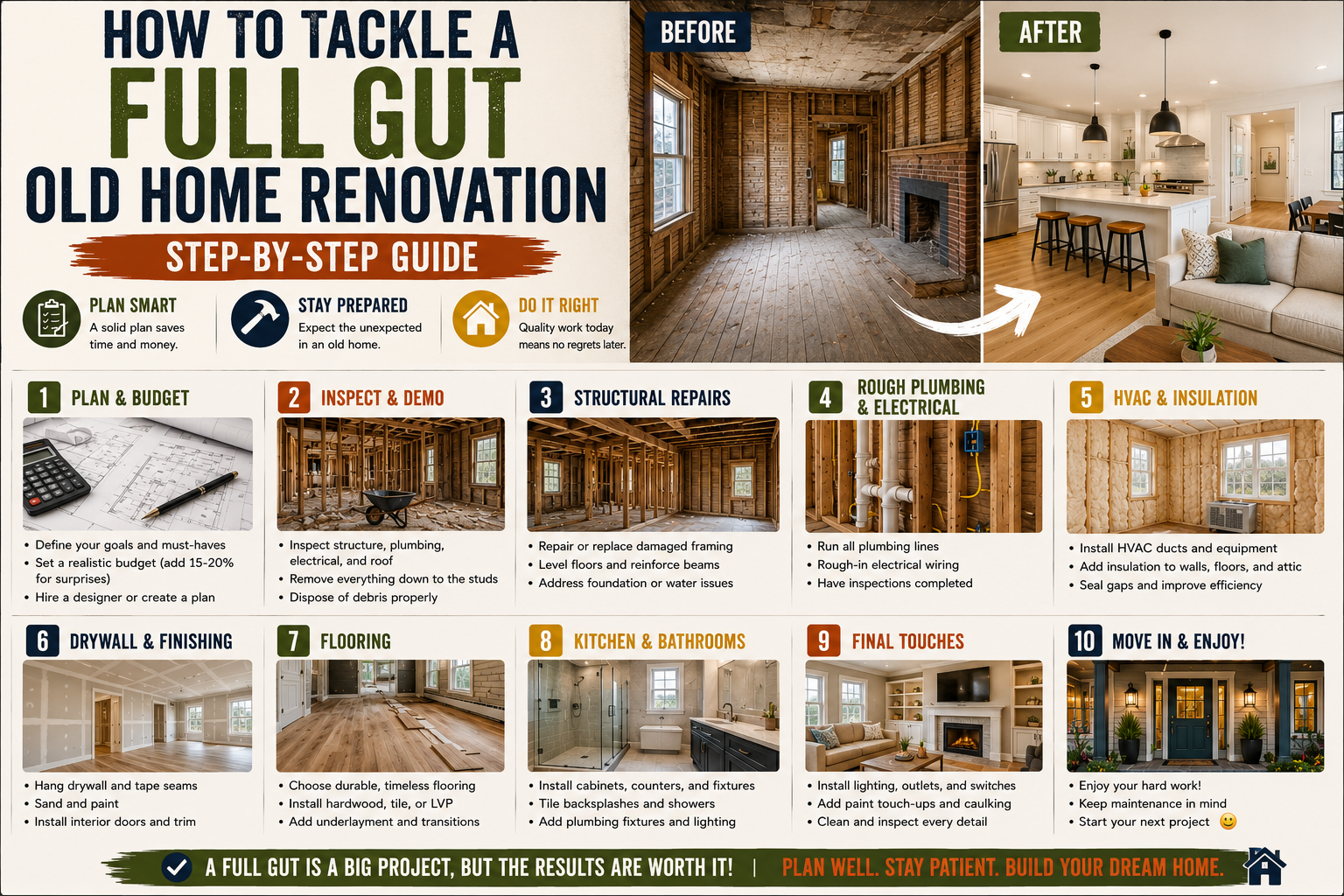
Map your utility rough-ins before framing closes in. Once walls go back up, moving a drain line or a gas connection gets expensive fast. Know which walls are load-bearing before anything structural is touched — in a house built before modern code, you can’t assume proper load paths exist just because a wall has been standing for decades. Sequence your subcontractors intelligently — demo first, then framing, then rough mechanicals, then insulation, then drywall boarding, then taping, then paint, then finish work. Skipping steps or working out of order creates expensive rework. And finally, budget a contingency of at least 15-20% on any old home renovation — surprises are not if, they’re when.
Frequently Asked Questions
What does a full gut renovation actually include?
A full gut renovation means stripping a home down to its bare structural framing — removing all wall finishes, flooring, ceilings, and often mechanical systems — and rebuilding everything from scratch. You’re essentially keeping the shell and rebuilding the interior. It gives you the cleanest possible canvas and eliminates the risk of hiding problems behind new finishes, but it’s the most labor-intensive and costly type of renovation.
How do I know if a wall in an old home is load-bearing?
In general, walls that run perpendicular to the floor joists and sit above a beam or foundation wall below are load-bearing. In a one-story home, walls that run parallel to the ridge of the roof are often (but not always) load-bearing. The safest approach is to consult a structural engineer or experienced framing contractor before removing any wall in an older home — especially because, as I found, old homes were often built without proper headers and load transfer details that modern construction requires.
Should I DIY the drywall taping on a renovation like this?
You can absolutely hang the drywall yourself — it’s physically demanding but straightforward with the right lift equipment. Taping and mudding, however, is a skill that takes real time to develop. For a whole-house renovation where the finish quality matters, I’d seriously consider subcontracting the taping and mudding to a professional. The cost is reasonable, and the quality difference on a full project is significant. I’m doing all the boarding myself but having a pro handle the tape.
What’s the biggest mistake people make on old home renovation projects?
Not dealing with moisture issues immediately when they’re found. Whether it’s a leaking chimney, a compromised window flashing, or a failed roof detail, moisture inside an old home has usually been there for years by the time you find it. Drywalling over it — even with the intention of fixing it “later” — virtually guarantees a mold and structural problem down the road. Stop, find the source, fix it completely, let everything dry out fully, and then proceed with your renovation. Everything else can wait.
Final Thoughts
Tackling a full gut old home renovation project is one of the most ambitious things a DIYer can take on — but it’s also one of the most rewarding. When I look at a 1920s house that needed everything and can see a clear path to transforming it into a home a family would be proud to live in, that’s the whole motivation right there. The key is going in with a solid plan, understanding the sequence of work, knowing where to DIY and where to bring in help, and never ignoring what the demo reveals.
If you’re in the early stages of planning something similar, I’d encourage you to start with a detailed walkthrough, document everything, and make your layout decisions before demo begins. Changes on paper cost nothing. Changes after framing is done cost a lot. Stay patient, stay organized, and the transformation will follow. Drop your questions in the comments — I read every one of them and happy to help you think through your specific project.