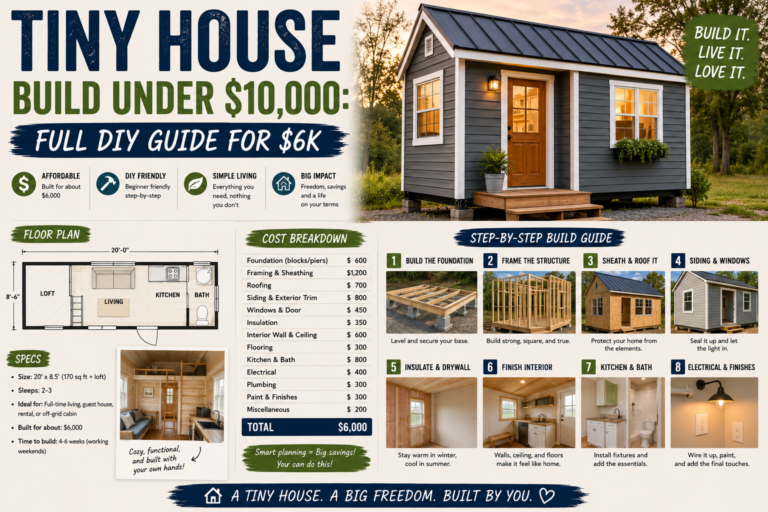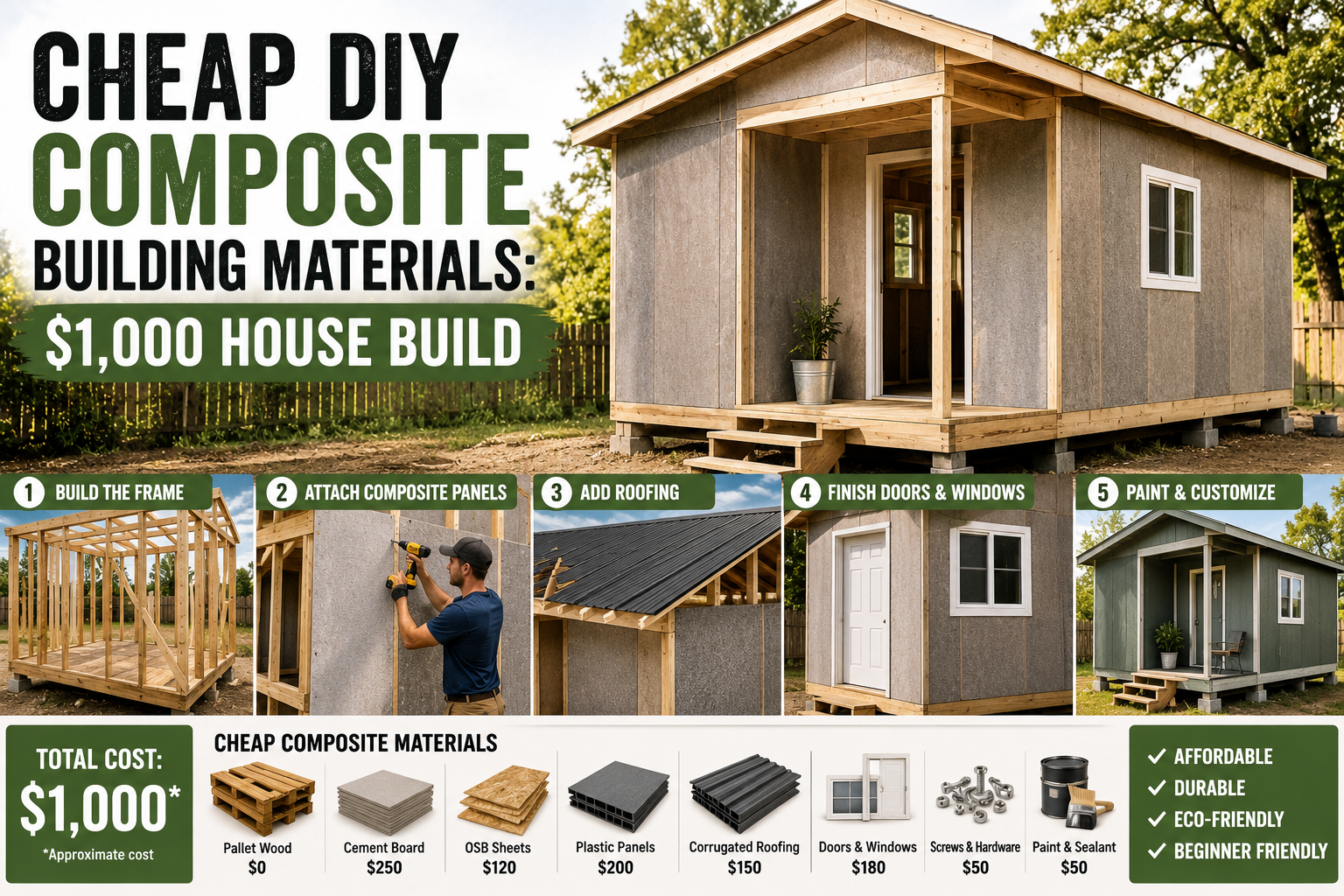
I’ve always believed that modern construction can be easy, simple, interesting, and inexpensive — you just need to look at it from a slightly different angle. When I started this project over a decade ago, I had one core idea driving everything: lightness instead of heaviness, and cheap homemade composite building materials instead of expensive traditional ones. What followed was one of the most challenging, rewarding, and genuinely eye-opening building experiences of my life.
This post walks through every phase of my $1,000 house build — from the very first experimental structures I cobbled together from leftover boards, all the way through roofing, windows, doors, and the foundation. If you’ve ever thought that building cheaply means cutting corners or ending up with something embarrassing, I want to show you that’s simply not true. Some of the most innovative building solutions I’ve ever come across came out of tight budget constraints. If you’re interested in more ways to stretch your budget on serious projects, my guide on budget home improvement DIY ideas that save thousands is a great companion read.
I’m going to cover every idea, material hack, structural technique, and lesson I picked up across years of experimenting. Whether you’re thinking about a backyard structure, a small cabin, or just want to understand what’s possible with cheap DIY composite building materials, this is for you. Let’s get into it.
Starting With Pseudo Timber — Turning Scrap Into Structure
The whole thing started with leftovers. I had boards from building my main house and scraps of old metal profile sitting around doing nothing, and I decided to use them to make what I call pseudo timber — essentially a composite structural element that mimics the look and performance of solid timber without the cost or weight. My first project with this material was a canopy over a new porch, and honestly, I was so pleased with how it came out that I immediately started thinking bigger.
The beauty of pseudo timber is right there in the concept: you’re combining materials that are individually weak or scrap-grade into something that performs like a proper structural element. The assembly process is straightforward enough that anyone can follow it, even someone brand new to construction. And one feature I appreciated from day one — the design is easy to assemble and disassemble, which means you’re never truly locked into a layout. That kind of flexibility is invaluable when you’re working on a tight budget and still figuring things out as you go.
Building the Lightweight Rafter System From Stored Parts
Before barrel saunas became the trend they eventually did, I had already built a lightweight yet sturdy rafter system. The parts had been stored in a covered area for years waiting for their moment, and when I finally started the $1,000 house in earnest, that moment had arrived. I used mostly 5×5 timber bars for the main construction — nothing fancy, just practical and affordable lumber that I was able to source in quantity without blowing the budget.
The frame made of pseudo timber was modified for this build — I decided to make the second floor a half-attic and leave the rafter system exposed rather than covering it up. That meant every element needed to look decent as well as perform structurally, so I carefully coated everything with a protective compound before assembly. One time-saving trick I developed early: I assembled one structure and used it as a template to assemble the rest. That kind of prefabrication mindset — building from a kit rather than fitting everything on-site — makes construction dramatically faster and more accurate. It’s something I carried through the entire project.
I also used special braces made from very thin profile pipes and threaded rods to precisely level and temporarily stabilize the structure during assembly. Once the walls were filled in, those braces came right out. Everything needed to be precise — this wasn’t rough-and-ready construction, it was careful, methodical work done on a shoestring.
Making Windows From Scratch — The Dollar-9 Window That Broke the Internet
Windows were one of the most creative challenges of the whole build. My inner voice strongly resisted bringing in used windows or secondhand junk, so I decided to make my own. I sourced discounted door frame blanks and modified the parts with a handsaw and chisel — nothing complicated — then connected them using furniture fasteners called confirmats. For the glazing itself, I managed to get new double-glazed units for next to nothing because they were the wrong size as measured by window installers who apparently never learned how to use a ruler. Their loss, my gain.
The first window I made was a fixed (non-opening) design, and I documented it in a video that eventually blew up online — bringing over 60,000 new subscribers to my channel. But the comment section made one thing very clear: people wanted an opening window. So I went back and made a second version — a casement window with a homemade double-glazed unit, assembled without any machines. That video brought another 20,000 subscribers. I thoroughly degreased the frame, applied silicone sealant generously before gluing the glass unit in, and finished the glazing bead over winter while editing footage. The result was a genuinely functional, well-insulated window built for almost nothing.
The lesson here is bigger than just windows: prefitting and preparing blanks in advance, then assembling them quickly on-site, is many times faster than trying to fit everything in place. I applied this thinking to every other part of the build. For more ideas on maximizing tight spaces with smart built-ins, check out my post on built-in bookshelves and home office storage.
The Ultra-Cheap Extruded Polystyrene Foam Roofing System
This is the part that I think is genuinely revolutionary, and it’s the one I’m most proud of from an innovation standpoint. I started experimenting with extruded polystyrene foam as a roofing material — yes, roofing — and the results were better than I expected. I used sheets that were only 3 cm thick, painted them with facade paint in two layers with drying time in between, then glued the sheets into strips along the length of the roof slopes.
To each glued strip, I attached a wooden bar. This was essential because the cheapest extruded polystyrene foam I was using would have been at risk of breaking during installation without that reinforcement. The roofing blanks were then fixed to the battens with foam adhesive and secured with self-tapping screws through the glued bars. Simple, light, fast. The total cost? $2.50 per square meter — meaning the entire roof cost under $100, all from new materials, not used ones.
And the performance exceeded my expectations. The ultra-cheap roofing turned out to be completely resistant to thermal expansion, able to withstand snow and heavy hail, and significantly quieter than metal roofing — which anyone who has sat inside a shed during a rainstorm under metal tiles will appreciate. I also added two skylights to the roof using sashes from a new window frame that installers had again messed up on size. The shade underneath on hot days was genuinely cool — nothing like the heat that builds under metal. Half the roof covered and you could already feel the difference.
Building a Homemade Door From Clapboard Scraps
The house needed another door, and true to the spirit of the whole project, I wasn’t going to pay retail for it. I initially considered using leftover clapboard, but that wouldn’t have made it super cheap. Instead, I went to the nearest woodworking shop and got clapboard scraps at firewood prices — the offcuts that shops would otherwise chip or burn. With those materials in hand, I made a door that I was genuinely proud of.
This is one of those cases where the constraint of the budget actually forces you to be creative in a way you wouldn’t be if money were no object. Sourcing clapboard scraps at firewood prices is the kind of move that sounds obvious once you hear it, but most people never think to ask. Woodworking shops and lumber yards regularly have cutoffs and reject pieces that are perfectly usable for smaller applications — doors, window frames, trim, decorative elements. It pays to ask.
The Barrel Sauna Detour — and What It Taught Me About Prefabrication
Before the $1,000 house got into full swing, I got somewhat distracted building barrel saunas — which turned into a small family business for a while. I built my first barrel sauna using a homemade sauna stove fabricated from used metal profiles. The only purchased components were a bit of forge strip and a cast-iron grate cut to size. I even reinforced the barrel floor before installing the stove and stones since the weight would have been significant.
The barrel sauna experience, despite not becoming the business I hoped for, gave me something more valuable: a deep understanding of the power of prefabricated, pre-fitted components. Assembling structures from ready-made blanks prepared in advance is many times faster than fitting everything on-site. That realization changed how I thought about the house build entirely. It also reinforced something about wood as a material — it requires thorough processing, treatment, and ongoing maintenance. The labor intensity of working with raw wood started pushing me toward thinking about composite and synthetic alternatives. If you want to explore more about shed and small structure builds, I covered a lot of the same territory in my post on cheap DIY off-grid shed builds.
Sourcing Materials for Almost Nothing — The Low-Cost Procurement Strategy
One of the most important skills I developed through this project is what I’d call strategic cheap sourcing. A friend named Valentine was a big influence here — his advice helped me get materials and components for the $1,000 house at very low cost. For example, I managed to get a plastic door in near-new condition for almost free simply because it had been slightly mistreated cosmetically. I got double-glazed window units for next to nothing because they were the wrong size. I got clapboard scraps at firewood prices. I used construction debris from my own porch rebuild as fill material.
The pattern is consistent: other people’s waste and mistakes are your budget building materials. Installers who can’t measure correctly, shops with offcut piles, people renovating and throwing out components that still have useful life — these are your suppliers when you’re working on a $1,000 budget. It requires more legwork and patience than just ordering everything new, but the savings are dramatic. The trade-off is time, not quality.
Foundation Work With Construction Debris and Permanent Formwork
The existing shed had left behind a foundation made of randomly placed concrete blocks, with one side made of red brick. Rather than demolishing it, I attached embedded parts to the blocks to secure the frame supports and worked with what was there. To raise and correct the geometry of the foundation, I used a permanent homemade formwork made from KTPS (extruded polystyrene), which I found myself liking more and more as a formwork solution — it stays in place and adds insulation value.
I poured half the foundation using construction debris as aggregate and the other half in the classic way using crushed stone mixed with debris. Honest assessment: the savings using debris are smaller than you’d hope because of cement overuse, and the process is far less enjoyable than clean aggregate. If I were starting from scratch on a clear site, I would have drilled holes with an auger and made a pile-and-beam foundation — much more material-efficient and faster. But you work with what you have. The important thing is that the foundation got corrected and raised to a geometry that the wall framing could actually work with.
Testing the Frame Through Multiple Winters — Climate and Time as Quality Control
One thing I’m genuinely proud of is the fact that I didn’t rush to call the frame finished and move on. The pseudo timber frame stood for several years through multiple winters before the full build came together, and that time served as a real-world test of the material and construction method. It faced temperature swings, snow loads, wind, and moisture — and it held up. By the time I was ready to enclose the structure, I knew from experience rather than theory that the frame was sound.
This kind of long-duration testing isn’t available to everyone, obviously — most people need their structure done on a schedule. But the principle matters: don’t rush to cover up structural elements before you understand how they’re performing. The exposed rafter system, carefully coated and left visible in the half-attic, was both a practical decision and a philosophical one. If the structure is well-made, there’s no need to hide it.
The Philosophy Behind the $1,000 House — Why Cheap Doesn’t Mean Bad
I want to spend a moment on the mindset behind all of this, because I think it’s as important as any specific technique. When I announced the $1,000 house project, I immediately got pushback — people telling me it was impossible to build anything meaningful for that budget. I expected that. But the critics were working from a traditional model of construction where you buy everything new, hire labor for everything you can’t do yourself, and treat time as essentially free.
My model flips that. Time and ingenuity substitute for money. You can build a house quickly for a million dollars — or you can build it slowly and smartly for a thousand. The materials I use — cheap DIY composite building materials made from combinations of polystyrene, scrap metal profiles, budget lumber, and salvaged components — aren’t inferior. They’re different. In some ways, like the polystyrene roof, they outperform conventional materials. The 50 square meter house at a cost price of $1,000 isn’t a compromise. It’s a demonstration of what’s possible when you stop assuming that the conventional way is the only way. For a deeper dive into high-ROI renovation thinking, my post on home renovation projects with high ROI covers a lot of the same territory from a different angle.
Tips and Best Practices for Working With Cheap DIY Composite Building Materials
After years of working with these methods and materials, here are the principles that have served me best:
Prefabricate off-site whenever possible. Assembling pre-fitted blanks is many times faster and more accurate than fitting components in place. Build one piece as a template and replicate it. This is how barrel sauna production works, and it applies just as well to wall panels, window frames, and roof strips.
Paint extruded polystyrene foam with facade paint before it sees sunlight. UV is the only real enemy of this material. Two coats with drying between them gives it significant protection and extends its useful life dramatically. Don’t skip this step.
Use furniture fasteners (confirmats) for joining window and door frame blanks. After simple modification with a handsaw and chisel, these connectors make joining pre-cut blanks fast and strong without specialized machinery.
Source from woodworking shops’ scrap piles. Clapboard scraps, offcuts, and reject pieces are often available at firewood prices or less. For small components like door panels, window frames, and trim, these scraps are perfectly adequate.
Think carefully before using construction debris as concrete aggregate. The cement overuse tends to erode your savings, and the process is unpleasant. Clean crushed stone produces better results for not much more money.
Use a thin-pipe-and-threaded-rod brace system for temporary stabilization during framing. It allows precise leveling and comes out cleanly once walls are filled. Far cheaper than permanent bracing solutions.
Attach wooden bars to polystyrene roofing strips before installation. This reinforcement prevents breakage of the lightweight sheets during handling and fastening, and gives you a solid point for screw attachment to battens.
Frequently Asked Questions
What exactly is pseudo timber and how do I make it?
Pseudo timber is a composite structural element made by combining leftover boards with scrap metal profile — in my case, old metal channel sections and standard dimensional lumber. The metal stiffens and reinforces the wood, while the wood provides the bulk and fastening surface. The result is a structural member that performs like solid timber but weighs less and costs far less, especially when you’re sourcing the components from your own scrap pile. The assembly is straightforward and doesn’t require specialized tools.
Is extruded polystyrene foam really a viable roofing material?
Based on my experience, yes — with the right preparation. The key steps are using sheets at least 3 cm thick, applying two coats of facade paint to protect against UV, gluing sheets into strips and reinforcing with a wooden bar before installation, and fixing to battens with foam adhesive plus self-tapping screws. The resulting roof is thermally resistant, handles snow and hail well, is quieter than metal, and costs around $2.50 per square meter. It’s not conventional, but it performs.
How do I source cheap or free building materials the way you do?
The main channels I use are: woodworking and window installation shops (for offcuts and mis-measured components), demolition and renovation projects (for reusable structural pieces and fill material), and simply asking around locally. Window and door installers regularly have units that were cut to wrong dimensions — these are functionally perfect and often available very cheaply. Cosmetically damaged materials like the plastic door I sourced are another great category. The common thread is that other people’s measurement errors and cosmetic damage are your opportunity.
Can someone with no construction experience tackle a project like this?
Absolutely — in fact, that’s one of the core principles of the whole approach. The technology is designed to be easy to learn, even for someone brand new to construction. The key is working from pre-fitted templates rather than measuring and cutting everything in place, using simple fastening methods like confirmats and self-tapping screws, and being willing to go slowly and think through each problem. A house for $1,000 takes more time and ingenuity than a house for $100,000 — but the skill level required is lower, not higher, because you’re working with lighter materials and simpler connections.
Conclusion — Start Building Smarter, Not More Expensively
The $1,000 house build is still one of the most technically and creatively satisfying projects I’ve ever taken on, precisely because of the constraints. Cheap DIY composite building materials — pseudo timber, polystyrene foam roofing, homemade windows from salvaged glass units — aren’t compromise solutions. They’re intelligent ones. Every material choice, every sourcing decision, and every construction method in this project was arrived at by thinking carefully about what actually matters structurally versus what we’re just conditioned to assume is necessary.
If this post has sparked any ideas, I’d encourage you to start small. Make one pseudo timber element and see how it performs. Source a sheet of extruded polystyrene and experiment with painting it. Ask your local woodworking shop if they have a scrap pile. The most important step is just beginning — the solutions develop as you go. Drop your questions in the comments below, and let me know what kind of budget build you’re planning. I read every one.