I had a bathroom countertop with a rust stain so bad it genuinely embarrassed me every time I looked at it. A mirror had sat on the marble surface for months, water collected underneath it, and by the time I finally got around to hanging the mirror, the damage was done. I tried every cleaning product and stain remover I could find online — nothing touched it. I was convinced my only option was a full countertop replacement, which meant spending hundreds or even thousands of dollars. Then I discovered microcement, and it completely changed how I think about DIY countertop makeover ideas.
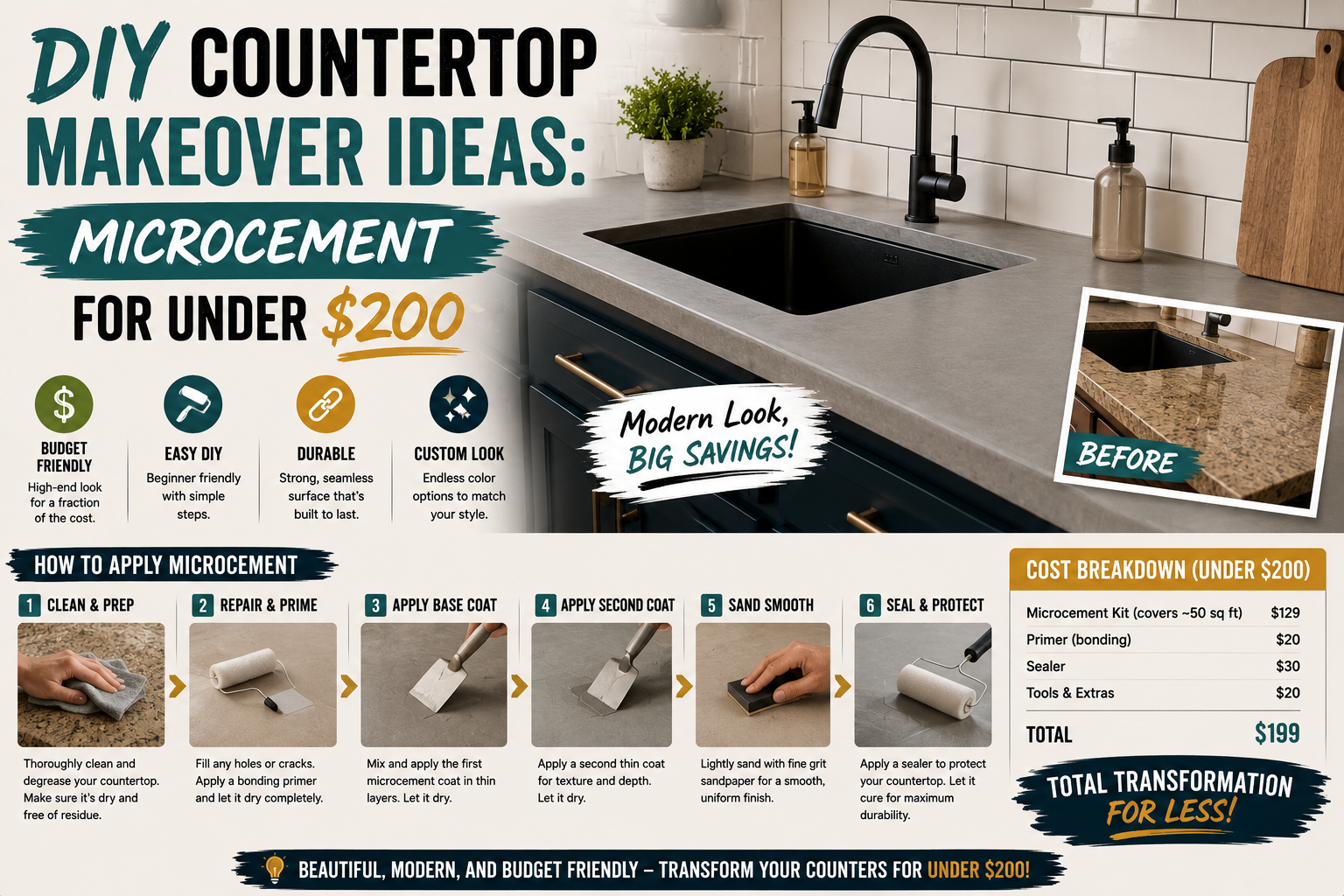
Here’s the thing most people don’t realize: you don’t have to demolish and replace a damaged, stained, or outdated countertop to make it look brand new. Microcement is a material that architects and high-end designers use, and it’s surprisingly DIY-friendly. In this post, I’m going to walk you through exactly how I used it to transform both a beat-up laminate test countertop and my marble bathroom vanity — including the mistakes I made so you don’t have to repeat them. The total cost? Under $200 for up to 37 square feet of coverage, which works out to less than $5 per square foot.
If you’re also exploring other ways to stretch your renovation budget, check out my post on Budget Home Improvement DIY Ideas That Save Thousands — it pairs perfectly with this project. Now let’s get into it.
What Is Microcement and Why Is It a Game-Changer for Countertops?
Before I dove into this project, I had to understand what I was actually working with. Unlike traditional concrete — which is thick, heavy, and full of chunky aggregate — microcement uses fine powders, polymers, and resins. It goes on top of almost any existing surface in a layer that’s only about 1/32 to 1/8 of an inch thick. That means no forms to build, no massive bags of concrete to mix, and no structural concerns. You’re essentially coating your existing countertop, not replacing it.
What really sold me on this approach was the versatility. Microcement can go on floors, walls, showers, and countertops — and it adheres to surfaces like marble, laminate, tile, and even wood with the right bonding primer. The finish is seamless, smooth, and genuinely looks like something you’d see in a high-end kitchen or bathroom renovation. It also comes in a wide range of colors: grays, whites, tans, browns, blacks, and more. I went with traffic white for my bathroom vanity, and I couldn’t be happier with how it turned out.
Test First: Practice on a Damaged Laminate Countertop Before the Real Thing
One of the smartest decisions I made on this project was testing the microcement on a sacrificial surface before touching my actual bathroom countertop. I picked up an inexpensive laminate countertop and deliberately damaged it to simulate a real worst-case scenario — burn marks, impact damage, screw holes, the works. If the product could handle that, I’d feel confident taking it to my marble vanity.
This test run taught me more than I expected. I learned how the material spreads, how it behaves on a non-porous surface, where it tends to drag or leave trowel marks, and how critical the bonding primer step really is. I also discovered that doing vertical surfaces like a backsplash after you’ve already smoothed the flat countertop surface is a mistake — the vertical work will mess up the flat section you just finished. Do your vertical areas first, then move to the horizontal surface. That one tip alone saved me a ton of frustration on the bathroom countertop.
Filling Voids and Prepping a Damaged Surface Before You Start
If your countertop has deep gouges, screw holes, or impact damage, you need to address those before applying microcement. Microcement is thin — that’s its whole advantage — but it’s not designed to fill large voids. For deep damage, I used Bondo body filler, which is cheap, fast-setting, and something I already knew how to work with. You could also use a thicker microcement fill product if you prefer to stay within one product system, but I found Bondo to be a perfectly reliable and budget-friendly option.
After filling, I sanded everything down with 80-grit sandpaper. I used an electric sander, but you can absolutely do this by hand — it just takes a bit more elbow grease. The goal isn’t a perfectly smooth surface at this stage; it’s a clean, scuff-roughened surface that gives the bonding primer something to grip. Once sanded, wipe everything down thoroughly to remove all dust before moving on.
Choosing the Right Bonding Primer for Your Countertop Material
This is where the process splits depending on what kind of countertop you’re working with, and it’s an important distinction. For a non-porous surface like laminate or Formica, you need a two-part bonding primer — the kind you mix by weight at a specific ratio (in my case, 5:1). You apply one coat, let it dry for about 12 hours, then apply a second coat and wait another 12 hours before proceeding. It’s a bit of a time commitment, but that primer is what makes the microcement actually stick to a slick surface.
For a porous surface like marble, the process is actually easier. I used a one-step deep primer that I could apply in two coats while the first coat was still wet — no waiting period between coats. This sped things up considerably. Either way, don’t skip the primer step. It’s the foundation of the whole project, and if it fails, everything on top of it fails too. Also, make sure your mixing tools are completely clean before you start mixing the microcement — I got some dried microcement flakes in my batch that tinted it slightly blue, which was a headache I could have avoided.
Mixing the Microcement: Ratios, Colors, and What to Watch Out For
Microcement comes in two parts: a powder (Part A) and a liquid (Part B). The mixing ratio is 100 parts powder to 20 parts liquid by weight — which is just a 5:1 ratio, so don’t let that number intimidate you. I used a kitchen scale to get accurate measurements, and I’d strongly recommend doing the same. The consistency you’re going for is similar to drywall mud or cake icing — smooth, spreadable, and not too runny.
For color, the instructions call for adding 3% of the total microcement weight in pigment. There are plenty of options available — grays, whites, tans, browns, blacks — so you can match almost any aesthetic. I went with traffic white for a clean, crisp look. One thing to keep in mind: once the top coat sealer is mixed, you have about 30 minutes before it starts to set. So before you mix the sealer, make sure your workspace is ready, your surface is prepped, and you’re not going to get interrupted. Move with purpose once that clock starts.
Applying the Microcement: Technique, Tools, and the Trowel Trick
Applying microcement is a skill, and I won’t pretend my first coat was flawless. The key is to hold your edge trowel at a slight angle — not flat against the surface — and drag it in smooth, even strokes. Laying it too flat causes the material to drag and leave ridges. Think of it like spreading a very thin layer of mud or icing: you want consistent pressure and a confident, fluid motion.
On porous surfaces like marble, I found the material wasn’t gripping as well as it did on the primed laminate. My workaround — and this one really worked — was to wet my fingers or a small cup with Part B liquid and use it to smooth over the surface after spreading. It acts exactly like water does when you’re finishing traditional concrete, allowing you to glide over the surface and eliminate drag marks. For rounded or decorative edges, this trick is especially helpful. Apply your microcement, then use a gloved fingertip moistened with Part B to smooth and round over those edges cleanly. It takes a little practice, but it works beautifully.
Sanding Between Coats for a Smooth, Professional Finish
After the first coat of microcement dries, sand it with 80-grit sandpaper before applying the second coat. This is non-negotiable if you want a smooth final result. The first coat will feel rough — almost like sandpaper itself — and that’s completely normal. Sanding knocks down the high spots and creates a better surface for the second coat to bond to.
I ran an experiment on my test countertop: I sanded one half before applying the sealer and left the other half unsanded. The sanded side came out noticeably smoother and cleaner. The unsanded side actually showed visible sanding marks and surface texture even after sealing. So do yourself a favor — take the extra 10–15 minutes to sand between coats. It makes a real difference in the final look. Let the second coat dry for a full 48 hours before moving on to the sealer.
Applying the Polyurethane Sealer: The Final Step That Locks It All In
The sealer is what makes your microcement countertop waterproof, durable, and ready for everyday use. The product I used was a polyurethane resin sealer with a matte finish — no high gloss, just a clean, natural-looking surface. The mix ratio for the sealer is 10:1 (not 5:1 like the microcement), so read the label carefully and don’t assume the ratios carry over.
Apply the sealer in a crisscross pattern — horizontal strokes first, then vertical — to ensure even coverage without missed spots. Work quickly because you’ve got about 30 minutes of working time once it’s mixed. Cover every inch of the surface, including the edges and any areas that were particularly rough or porous. Where the sealer doesn’t fully penetrate, water will absorb into the microcement, so thorough coverage is critical. Once it’s dry, you’ll have a countertop that looks completely seamless and feels as smooth as stone.
Reinstalling Your Faucet and Finishing Touches
Once the sealer is fully cured, it’s time to put everything back together. Remove any tape or protective coverings from the sink (and learn from my mistake — don’t put blue tape inside the sink basin, because it creates problems when you’re trying to work around it). Reinstall your faucet and any other fixtures, and take a step back to appreciate the transformation.
When I got my faucet back in and everything was cleaned up, the whole countertop just clicked into place visually. What had been an embarrassing rust-stained marble surface was now a clean, crisp, white countertop that looked completely new. Adding a fresh mirror and upgrading the soap dispenser to match the new look can really complete the refresh without spending much more money. Small finishing touches make a big difference when the main surface looks this good.
What Does a Microcement Countertop Makeover Actually Cost?
This is the part I know everyone wants to hear. Here’s the full cost breakdown from my project. The microcement set for wet areas — which includes the matte polyurethane sealer — runs about $126. Depending on your surface type, the bonding primer is either $27 (one-step deep primer for porous surfaces like marble) or $58 (two-part bonding primer for non-porous surfaces like laminate). That puts your total investment at somewhere between $153 and $184, well under $200.
That kit covers 37 square feet, which works out to less than $5 per square foot. Compare that to the cost of new laminate countertops ($20–$50 per square foot installed) or stone countertops ($50–$100+ per square foot installed), and the savings are staggering. Even if your countertop is larger and you need multiple kits, you’re still coming in at a fraction of the replacement cost. For anyone exploring Affordable Home Improvement Projects Under $100 or just trying to stretch a tight renovation budget, microcement deserves serious consideration.

Tips and Best Practices for Your Microcement Countertop Project
After going through this process twice — once on a test laminate countertop and once on a real marble bathroom vanity — here are the most important lessons I’d pass on to anyone tackling this project:
Always do a test run first. Pick up an inexpensive piece of laminate countertop and practice your technique before touching your actual surface. The learning curve is real, and you don’t want that curve to happen on your kitchen or bathroom countertop. Do vertical surfaces before horizontal ones. If you’re covering a backsplash in addition to the countertop, do the vertical work first. Going back to the vertical surface after you’ve smoothed the horizontal one will drag the fresh microcement and ruin your work.
Keep your tools immaculately clean. Any dried microcement left on a mixer, trowel, or bowl can break off and contaminate your fresh batch, changing the color and texture. Wash everything thoroughly between uses. Use Part B liquid to smooth difficult edges. Moistening your gloved fingers with the Part B liquid lets you glide over radiused or decorative edges without dragging the microcement. This is the single most useful technique I discovered on this project. Sand between every coat. It feels like extra work, but it’s what separates a rough, amateur-looking result from a smooth, professional one. Use 80-grit and don’t skip it. And finally, protect your floors and surrounding surfaces before you start. Microcement tracks easily and is a pain to remove once it dries on surfaces you didn’t intend to coat.
Frequently Asked Questions About DIY Countertop Makeover Ideas
Can microcement be applied over any countertop surface?
Microcement can be applied over most existing countertop surfaces, including marble, laminate, Formica, tile, and even some wood surfaces. The key is using the right bonding primer for your specific surface type. Non-porous surfaces like laminate require a two-part bonding primer, while porous surfaces like marble can use a simpler one-step deep primer. As long as the surface is structurally sound, clean, and properly primed, microcement should adhere well.
How durable is a microcement countertop compared to a real stone countertop?
When properly sealed with a polyurethane resin top coat, microcement countertops are waterproof, stain-resistant, and durable enough for everyday kitchen and bathroom use. They’re not as hard as granite or quartz, so I’d recommend using cutting boards rather than cutting directly on the surface. With reasonable care, a properly sealed microcement countertop should hold up for many years. The sealer can also be reapplied if needed to refresh the surface over time.
How long does the entire microcement countertop process take from start to finish?
Budget about four to five days total, though most of that is drying time rather than active work. The bonding primer requires 12 hours between coats for non-porous surfaces. Each coat of microcement needs 24–48 hours to fully dry before sanding and recoating. The final sealer needs time to cure as well. Active hands-on time is probably three to four hours spread across those days. It’s a patient person’s project, but the waiting is mostly hands-off.
Is microcement a good DIY countertop makeover idea for kitchens as well as bathrooms?
Absolutely. Microcement is rated for wet areas, which makes it suitable for both kitchens and bathrooms. The product I used was specifically the wet-area kit, which includes a more robust sealer designed to handle moisture and regular cleaning. For kitchens, just make sure you seal thoroughly and be mindful of heat — use trivets for hot pots rather than placing them directly on the surface. It’s one of the most cost-effective DIY countertop makeover ideas I’ve come across for either space. If you want more ideas on transforming a kitchen on a budget, my post on Budget Kitchen Renovation Under $5,000 has plenty of inspiration.
Final Thoughts: A Countertop Transformation for Under $200
I’ll be honest — when I first applied that first coat of microcement and saw how rough and uneven it looked, I had serious doubts. But after sanding, applying the second coat, sealing it, and living with it for about a week, I genuinely love how it turned out. The bathroom vanity went from having a rust stain I was embarrassed to look at to a clean, smooth, white surface that looks completely new. The faucet going back in really completed the whole look.
For less than $200 in materials and a few hours of actual hands-on work spread over several days, this is one of the most impactful DIY countertop makeover ideas I’ve ever come across. If you’ve got a damaged, stained, or just plain outdated countertop and you’re dreading the cost of replacement, I genuinely think microcement is worth trying. Do a test run first, follow the steps carefully, and you might be as surprised as I was by the result. For even more budget-friendly transformation ideas, browse through my guide on 10 Home Renovation Ideas on a Budget for a Dated House — there’s no shortage of ways to make a big impact without breaking the bank.